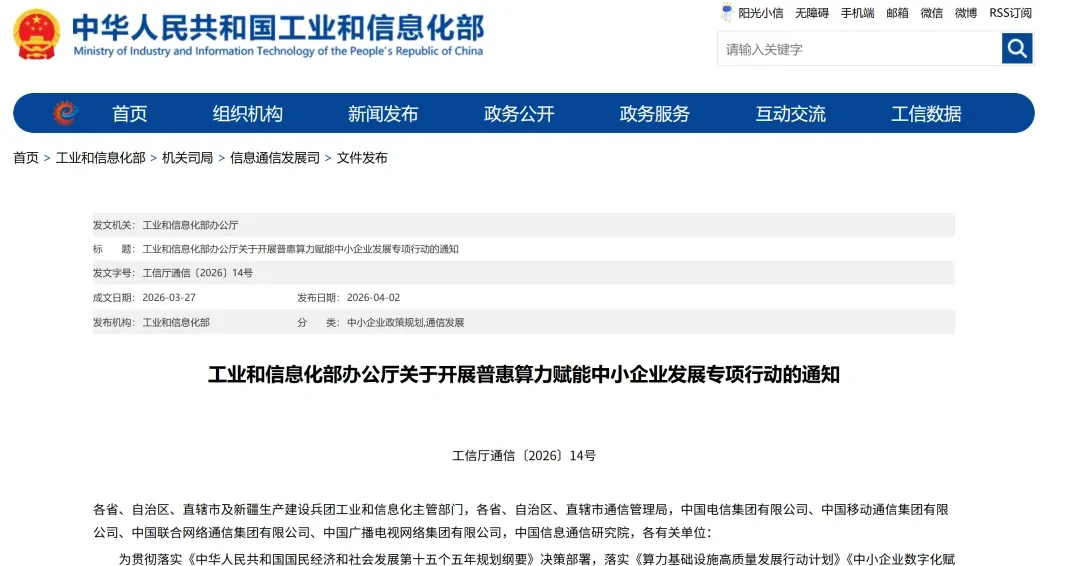
Policy Update: MIIT Launches Special Initiative to Make Computing Power Accessible for SMEs!

Recently, the General Office of the Ministry of Industry and Information Technology issued the "Notice on Launching a Special Action to Empower SME Development through Inclusive Computing Power" (MIIT Communication [Year 2026] No. 14), clearly stating that by the end of 2028, a broad-coverage, low-cost, high-quality service system with an active ecosystem and strong talent pool for inclusive computing power will be basically established. The launch of this special action marks that computing power is becoming the "new infrastructure" for digital transformation in SMEs—much like electricity and water—and a wave of computing power empowerment for SMEs has officially begun.
Core Policy: Five Initiatives to Lower Compute Access Barriers
This special campaign focuses on five key tasks to systematically address core pain points faced by SMEs in computing power access, application, and cost.
Action to Enhance Computing Resource AllocationGuide the development of edge data centers, establish exclusive computing power pools for SMEs, and promote the integration of idle computing resources to ensure computing power is "locally accessible and elastically available."
Inclusive Supply Action for Computing Power ServicesInnovate models like "Computing Power Bank" and "Computing Power Marketplace," adopt flexible "GPU-hour" and "CPU-core-hour" billing, and directly reduce enterprise costs through initiatives such as issuing "Computing Power Vouchers."
Empowerment Initiative for Key Industries and EnterprisesFocus on key industries such as manufacturing, education, agriculture, and finance. Promote low-cost, lightweight computing solutions to accelerate the integration of artificial intelligence and other technologies with business scenarios.
Industrial Ecosystem Co-Creation InitiativeEstablish a "1+N" partnership mechanism linking large, medium, and small enterprises; encourage leading enterprises to share idle computing resources and help SMEs integrate into the computing ecosystem.
Talent Development Capability Enhancement InitiativeDeliver tiered and categorized computing power training to comprehensively enhance strategic awareness among managers and hands-on skills for technical experts.
Opportunities and Challenges: How SMEs Can Ride the Wave
Policy support is here, yet many SMEs still face real barriers in moving from "having compute power" to "using it effectively": high technical thresholds, significant upfront costs, difficulty integrating with existing business operations, and a shortage of skilled运维 talent. While these policies aim to clear such hurdles, companies must also identify the right pathways and partners to transform accessible compute into tangible competitive advantage and growth momentum.
The key is whether you can obtain a ready-to-use service that is deeply integrated with your business scenarios.As highlighted in the policy on "empowering SMEs in manufacturing to undergo intelligent transformation and digitalization," we should encourage the development of integrated solutions combining computing power, platforms, and applications, delivering full-stack services from underlying resources to upper-level applications.
Chuling Shares
An integrated transformation engine delivering "compute power + platform + applications" for small and medium-sized enterprises
Amidst the transformation opportunities presented by inclusive computing power policies, Chuling not only helps enterprises build a three-tier capability framework of "computing power + platform + application,"MoreDeeply integrate full-optical network infrastructure for SMEs with vertical industry use cases.Empower computing power to be truly accessible, easy to use, and ready for deployment.
Chuleng Shares leverages a "cloud-edge-end" collaborative enterprise intelligent computing network architecture to empower manufacturing enterprises.End-to-end capabilities spanning from underlying compute infrastructure to upper-layer business operations.:
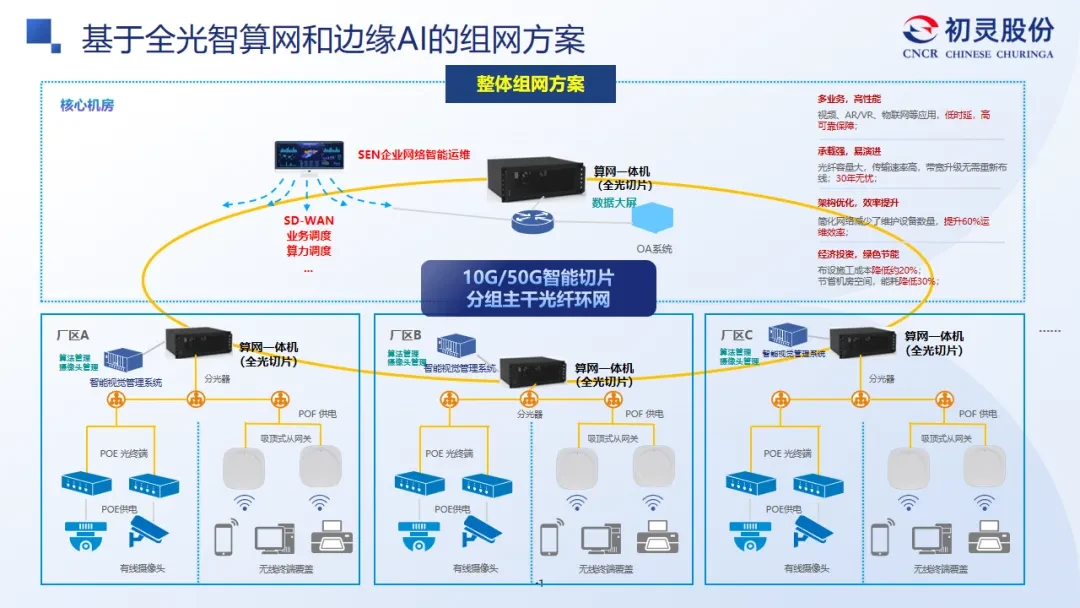
Computing power layerChu Ling has providedIntegrated GPU/CPU Computing Network ApplianceIntegrates optical network access, edge computing scheduling, remote terminal power supply, and NVR video storage into a unified solution. Paired with an all-optical slicing network featuring a 1G intelligent slicing group backbone ring (with smooth upgrade path to 5G), it enables deployment of high-bandwidth, low-latency, and highly reliable edge computing node architectures within the production workshop. This directly addresses policy requirements under the "Computing Resource Allocation Enhancement Initiative" for "edge data centers" and "elastic availability."
Platform Level——EDPS as the data management hubEquipped with capabilities for data collection, cleaning, storage, invocation, analysis, and sharing; comprehensively processes network data, business data, and system data from production, security, and alerting domains.EMAAS builds a collaborative mechanism of "large models + small models"Significantly reduce false positives and negatives while supporting rapid model iteration.ECPS enables virtualization and intelligent scheduling of heterogeneous computing resources, ensuring full utilization of computing power. Together, they provide a unified data foundation and AI capabilities to support upper-layer applications.
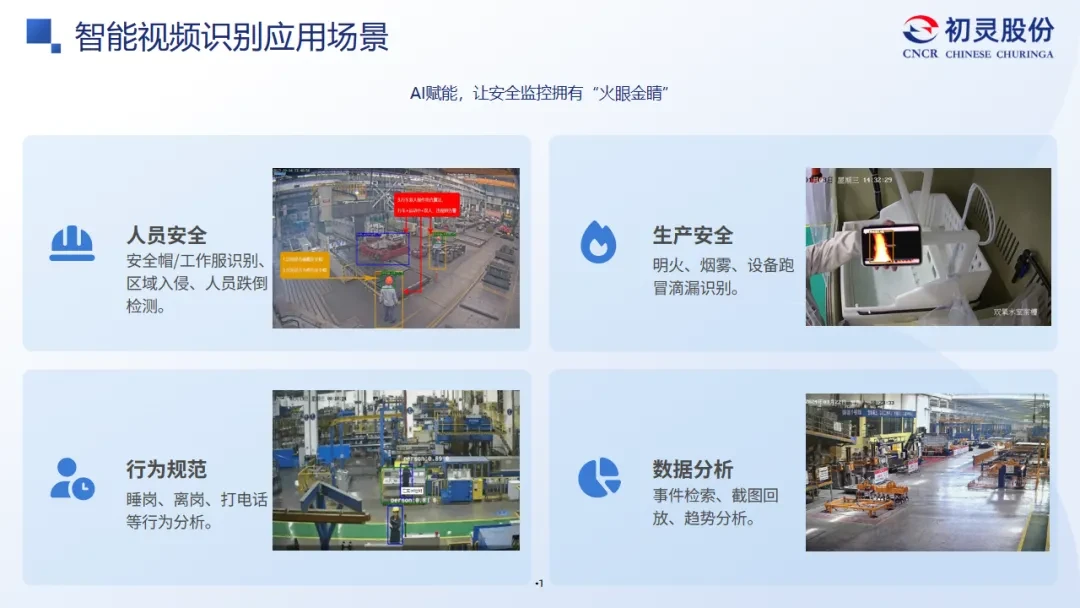
Application Level—— Chuling Shares' "AI Employees" cover key scenarios including network, quality, security, and inspections: such asSEN Enterprise Network AgentAchieve end-to-end network quality visibility, AI-driven fault diagnosis, and remote app operations.EHS Safety Control AssistantUse video analytics to detect risks such as crowd gathering, open flames, smoke, and missing hard hats; trigger real-time alerts via warning lights and sirens.EHS Smart Inspection AssistantIntegrate drones and inspection robots for automated inspections to boost efficiency. These AI-driven solutions enable enterprises to achieve a closed-loop process of "risk prediction, process control, and compliance traceability," effectively reducing safety incident rates and compliance costs.