
Industry Insights | State Council Meeting Sends Key Signal: Computing Power Network — The Core Foundation of the AI Era

As large models and AI applications move into industrial deployment, single-point computing power can no longer support massive training and inference demands. A unified, cross-region interconnected computing network that integrates compute and networking is becoming an essential foundation for the AI industry.

The State Council Executive Meeting held on 2026-9-11 stated: "Computing power networks are the foundational support for AI development."
The meeting outlined a comprehensive deployment for computing power infrastructure development: adhere to rational planning and standardized implementation to further enhance the infrastructure, actively advance the research, development, and application of key technologies and equipment, and build a multi-layered networked computing system; promote synergy between computing and power, integration of computing and networking, strengthen monitoring and scheduling of computing resources, and reinforce backbone fiber optic network construction; ensure seamless planning alignment between computing and power facilities, and accelerate the rollout of projects such as direct green power connections and source-grid-load-storage systems; leverage market mechanisms to support enterprises in technological innovation, resource integration, and application promotion, thereby better aligning supply with demand.
Under top-level guidance, the computing power network is no longer a simple overlay of data centers and fiber networks; it has become a strategic infrastructure supporting the long-term development of the AI industry.
Computing Power Network: Breaking Silos for AI Growth
Many mistakenly equate compute power simply with hardware like servers and GPUs. However, as the AI industry scales, merely stacking hardware hits clear bottlenecks: data centers scattered across regions operate in isolation, creating "compute silos." Large-scale model training over long cycles and real-time inference across diverse scenarios often require cross-regional resource scheduling, demanding extremely high performance in network latency, bandwidth, and coordinated resource orchestration.
The core value of the computing power network lies in connecting isolated compute nodes and orchestrating compute, storage, and network resources as a unified system, enabling on-demand access to computing power just like utilities.
Currently, China is accelerating the construction of a national integrated computing network. This initiative establishes a "8+10+3" spatial layout centered on 8 national computing hubs, 10 computing clusters, and 3 regions for synergistic development of computing and power. As a result, the total scale of national computing infrastructure is growing rapidly, computing-power synergy is advancing in depth, and the integration of computing and networking is accelerating.
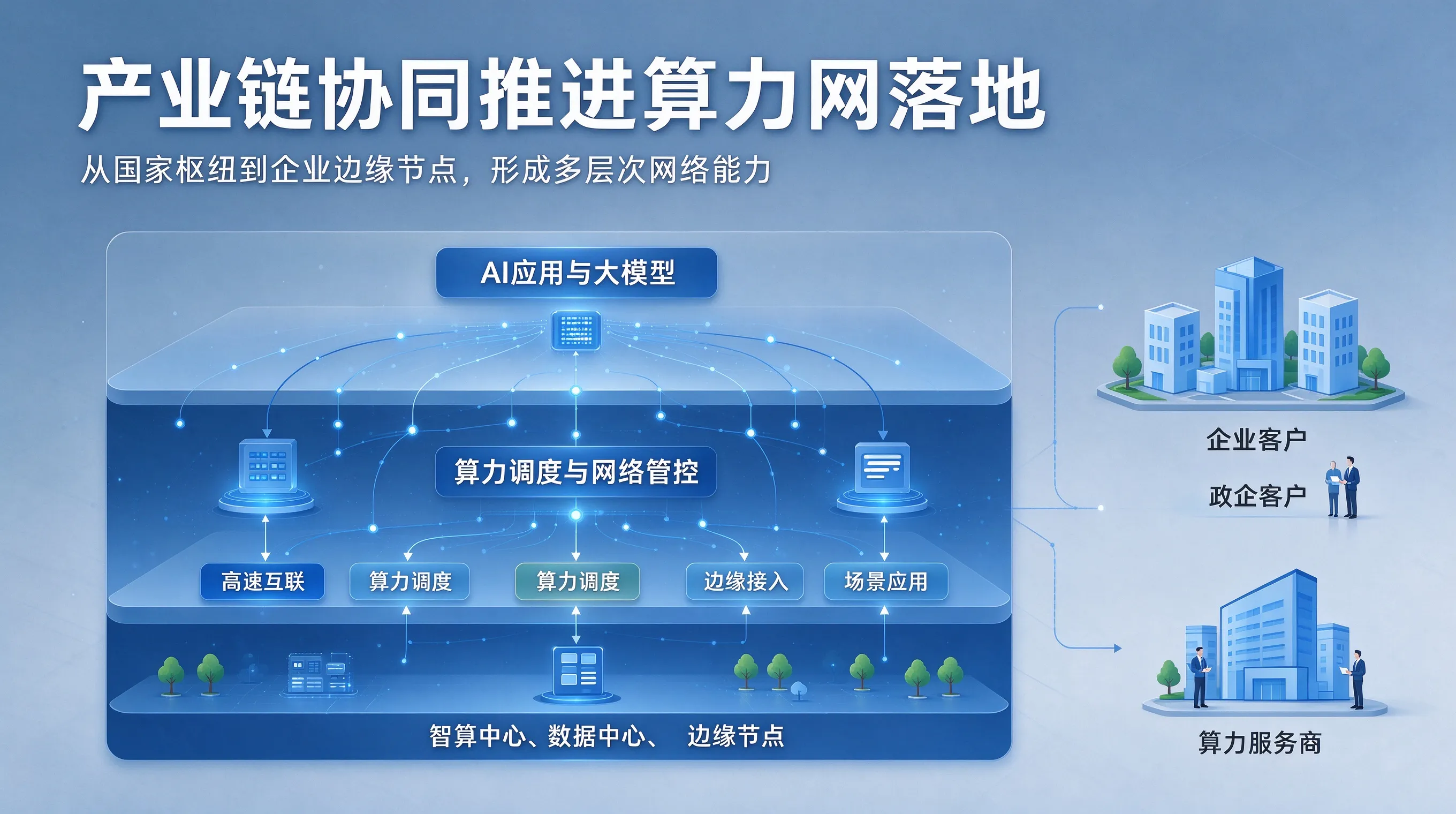
In the future, we will build a three-dimensional computing power supply system centered on hubs, regions, and edges: western computing hubs will handle long-duration training tasks for large models, while eastern nodes will support low-latency inference workloads.Edge computing is deployed at enterprise and campus sites to meet local AI application needs.
Meanwhile, the meeting emphasized the synergy between computing and power, as well as the integration of computing and networking. Zhu Keli, founding director of the National Academy for New Economy Research, pointed out that planning coordination between computing and power facilities and direct green power connections can effectively reduce energy costs for computing and enable its low-carbon development. Leveraging computing resource monitoring and scheduling along with backbone fiber optic networks enables unified computing dispatch, intelligent matching, and low-latency transmission.
The policy also emphasizes leveraging market mechanisms to encourage industry chain enterprises to drive technological innovation, resource integration, and practical implementation. Building the computing network requires coordinated national hub initiatives alongside contributions from industry chain enterprises providing hardware, software, and solutions. These enterprises must deploy integrated computing and networking capabilities at the enterprise and edge levels.
Chuling: Building a dedicated, controllable, telecom-grade enterprise computing network for corporate AI.
In the development of computing networks, many enterprises have focused on the integrated computing and networking sector, deploying AI computing network technologies and products for the enterprise market. Chu Ling is among them.Leveraging 20's decades of telecom network expertise, Chuling focuses on the enterprise digital intelligence market, enabling enterprises to build a dedicated, controllable, carrier-grade AI compute network (full-optical intelligent computing network).
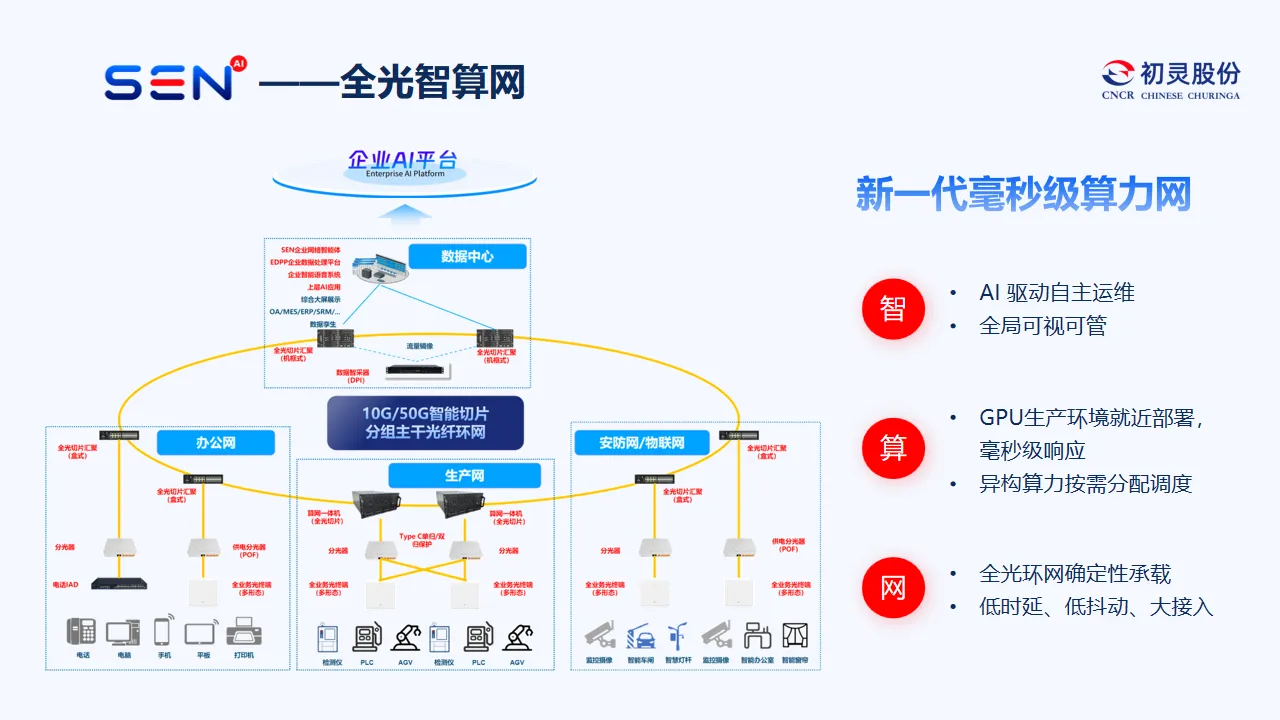
Technically, Chuling leverages SEN (Enterprise Network Agent) + SPN-FTTO (Sliced Packet Networking for Fiber to the Office) + DPI (Deep Packet Inspection) to deliver 10G full-area coverage and seamless WiFi roaming.
For medium and large enterprisesBuild a next-generation intelligent network that is flexible, low-latency, and highly reliable to support multiple AI scenarios in a ring topology.For small and medium-sized businessesBuild a full-optical intelligent network powered by cloud-based SEN (Enterprise Network Agent), FTTO, and computing technology. Deliver end-to-end network services including gigabit coverage design, installation, operations, maintenance, and computing resource scheduling. Enable seamless one-click ordering for SMEs to enjoy worry-free NAAS experiences.
Deployable in industrial parks, corporate offices, and production environments.Integrate edge computing with full-optical networks to support the deployment of enterprise AI employees and local model inference, helping businesses build dedicated compute networks (full-optical intelligent computing networks).
Computing power network construction advances steadily, solidifying the long-term foundation for the AI industry.
The innovation and iteration of artificial intelligence depend on the continuous improvement of underlying infrastructure.The State Council's deployment of the computing power network clearly defines the industry development logic: as AI advances upward, the computing power network must take root downward.
From building backbone networks for national computing hubs to deploying edge intelligent computing networks in enterprises and industrial parks, the entire industry chain must collaborate continuously. In the future, as the integration of computing and networking and the coordination between computing and power continue to take shape, the efficiency of computing resource utilization is expected to improve further, providing a stable and reliable foundation for AI transformation across all industries.
Compute power is productivity; networks are the connectors. An efficient, green, and schedulable compute network will provide a solid foundation for AI innovation and empower the development of new quality productive forces.